

Search engines are built on the premise that not all web pages are created equal. When Google was founded in the late 1990s, its founders introduced a groundbreaking way to evaluate a webpage’s importance, not by its content alone, but by the quality and quantity of links pointing to it. That method is the PageRank algorithm, and it fundamentally changed how the web is indexed and ranked.
Understanding PageRank is essential for anyone serious about search engine optimization (SEO), web development, or digital marketing. This guide explains what PageRank is, how it works mathematically and conceptually, how relevant it still is today, and how it has evolved within Google’s modern ranking system.
Want Your Business to Rank First in Vancouver Searches?
Knowing how PageRank and Google’s modern ranking signals work is the easy part; applying them in a market as competitive as Vancouver is where most businesses get stuck. Our team at Digital Connect Marketing builds Local SEO in Vancouver strategies that put you in front of customers on Google Search and Maps, not just in theory.
A Brief History of PageRank
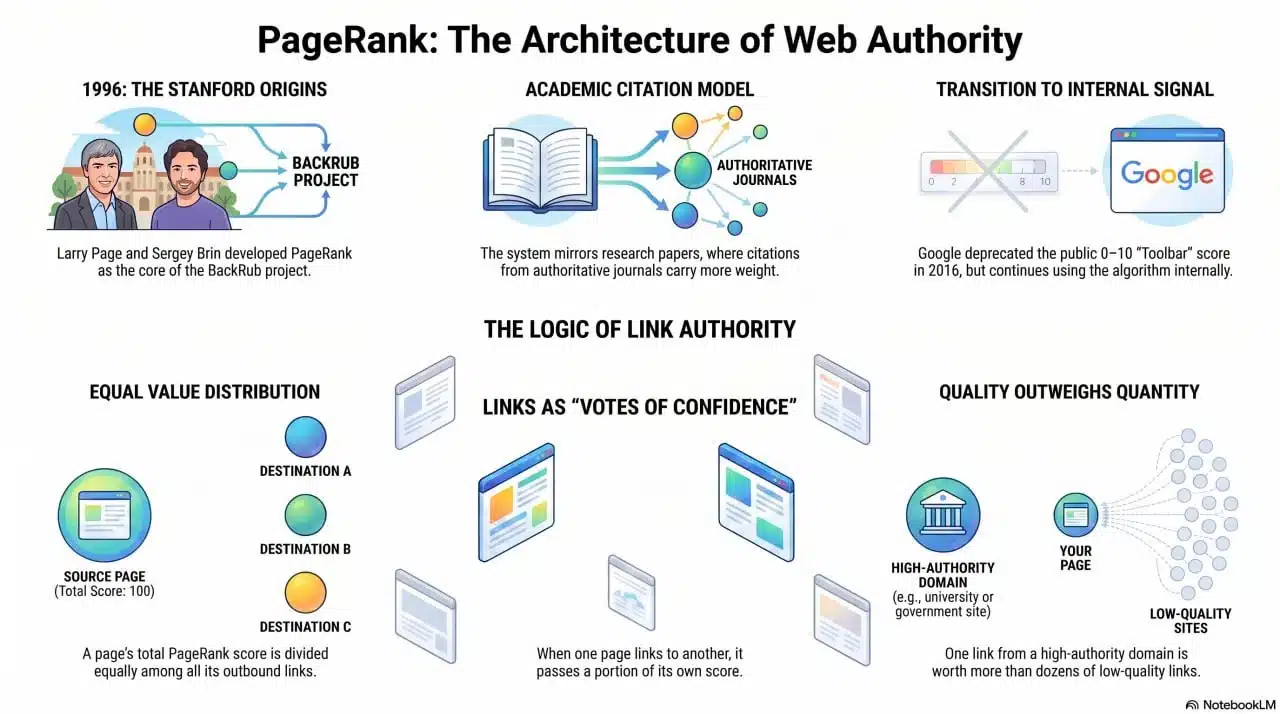
PageRank was developed by Larry Page and Sergey Brin at Stanford University in 1996. The algorithm formed the foundation of their research project, a search engine they called BackRub, which later became Google. The name “PageRank” is a play on Larry Page’s surname as well as the idea of ranking web pages.
In 1998, Page and Brin published their landmark paper, “The Anatomy of a Large-Scale Hypertextual Web Search Engine” which described how the algorithm used the link structure of the web as a proxy for authority and relevance. Google Inc. was incorporated that same year, with PageRank as its core ranking signal.
For years, Google publicly displayed a PageRank score, on a scale from 0 to 10, in its Google Toolbar, giving webmasters a visible signal of a page’s perceived importance. This Toolbar PageRank was retired in 2016, though the underlying algorithm continued operating internally.
How PageRank Works
At its core, PageRank is a link analysis algorithm that assigns a numerical score to every page on the web. The score reflects the probability that a person randomly clicking links will arrive at a given page. Pages with more high-quality inbound links receive higher scores and, consequently, higher positions in Google’s search results.
The Link Analysis Concept
PageRank treats every hyperlink on the web as a vote of confidence. When one webpage links to another, it passes along a portion of its own PageRank score to the destination page. This idea mirrors academic citation analysis, a research paper cited by many authoritative journals carries more credibility than one cited by obscure, low-quality sources.
The algorithm works iteratively. Google crawls the web, maps the link graph between pages, and calculates each page’s score based on the scores of the pages linking to it. This process repeats until the values stabilize, a mathematical concept known as convergence. The result is a relative ranking of every indexed page, from the most authoritative to the least.
The Role of Backlinks
Backlinks, links from external websites pointing to your page, are the fuel that drives PageRank. However, not all backlinks are equal. The algorithm accounts for two key variables:
- Source authority: a link from a high-PageRank page passes more value than a link from a low-PageRank page.
- Link distribution: a page’s PageRank is divided equally among all of its outbound links, so a page linking to 100 other pages passes less value per link than a page linking to only 5.
This means a single backlink from a highly authoritative domain, such as a major news outlet or a university, can be worth far more in ranking power than dozens of links from low-quality or newly created sites.
The Damping Factor Explained
One of the most important components of the PageRank formula is the damping factor, represented by the variable d, typically set at 0.85.
The damping factor models realistic user behavior: a person browsing the web does not click links indefinitely. At some point they stop and start a new session from a random page. The damping factor (0.85) represents the probability that the user continues clicking to another link, while the remainder (0.15) represents the chance they abandon the current path and jump to a random page elsewhere on the web.
The simplified PageRank formula looks like this:
PR(A) = (1 − d) + d × (PR(T1)/C(T1) + PR(T2)/C(T2) + … + PR(Tn)/C(Tn))
Where:
- PR(A) is the PageRank of page A
- d is the damping factor (0.85)
- T1…Tn are pages linking to A
- C(T) is the number of outbound links on page T
This formula ensures that even pages with no inbound links receive a small baseline score, preventing any page from having a PageRank of zero and keeping the algorithm mathematically stable.
Why PageRank Still Matters for SEO
PageRank introduced the foundational principle of link equity, the idea that links carry measurable value and transfer authority from one page to another. This principle remains central to SEO today.
From a practical standpoint, PageRank reshaped how webmasters, marketers, and publishers think about their content and its place in the web’s link ecosystem. Several core SEO concepts derive directly from it:
- Domain Authority and Page Authority, metrics developed by Moz as proxies for PageRank-like signals
- Link building strategies focused on earning backlinks from high-authority sources
- Internal linking that distributes link equity across a site’s most important pages
- Toxic link avoidance, to keep low-quality or spammy backlinks from harming rankings
Understanding PageRank also underpins competitor backlink analysis, identifying who links to top-ranking pages and building a strategy to earn similar links.
Is PageRank Still Used Today?
Yes, but it operates in ways that are far less transparent than in its early years. Google has confirmed that PageRank remains part of its ranking systems, though it is now one of hundreds of signals used to evaluate a page.
A 2020 leak of internal Google documentation pointed to continued use of a site-level version of PageRank-style signals, and Google’s Search Relations team, including Gary Illyes, has said publicly that PageRank still runs as part of the core indexing infrastructure. As with any unofficial or secondhand source, these claims are worth treating as directional rather than a precise technical specification.
What has changed is accessibility. The public Toolbar PageRank score was removed in 2016, leaving SEO professionals to rely on third-party authority metrics such as Ahrefs Domain Rating (DR) and URL Rating (UR), Moz Domain Authority (DA) and Page Authority (PA), and Semrush Authority Score. These proprietary metrics attempt to approximate the PageRank-like signals Google uses internally, though none are official replacements.
PageRank vs. Modern Authority Metrics
Because PageRank itself is no longer public, most SEOs now triangulate authority using third-party metrics. Here’s how the main ones compare:
| Metric | Source | What It Measures | Public Access |
|---|---|---|---|
| PageRank (original) | Link-based authority via the random surfer model | Discontinued (Toolbar retired 2016) | |
| Ahrefs Domain Rating (DR) | Ahrefs | Relative backlink profile strength of a domain, scored 0–100 | Public, via Ahrefs |
| Moz Domain Authority (DA) | Moz | Predictive score of ranking potential based on link profile | Public, via Moz |
| Semrush Authority Score | Semrush | Composite of link power, organic traffic, and spam signals | Public, via Semrush |
Limitations of PageRank
Despite its elegance, PageRank has several well-documented limitations, many of which motivated Google to develop additional ranking signals:
- Susceptibility to manipulation: in the early 2000s, webmasters discovered they could artificially inflate PageRank through link schemes, networks of sites exchanging or buying links purely to game the algorithm. This led to a cottage industry of link farms and black-hat SEO tactics.
- Inability to assess content quality: PageRank measures link popularity, not content relevance or accuracy. A page could rank highly despite containing outdated, misleading, or low-quality information, simply by accumulating enough inbound links.
- Temporal limitations: the original algorithm did not account for the age or recency of links, so a newly published, highly relevant article could rank below older pages that had simply accumulated links over time.
- No context or intent: PageRank treats all links to a page as roughly equivalent, regardless of the topical context of the linking page, a backlink from a food blog to a legal services firm carries the same raw vote weight as one from another law firm, an obvious imprecision.
These limitations drove Google to continuously layer additional signals and systems on top of PageRank.
How Google’s Ranking Signals Have Evolved Beyond PageRank
Google’s ranking system has evolved dramatically since the early days of PageRank. Today, Google is estimated to use 200+ ranking signals, with PageRank operating in the background as part of a far more complex infrastructure. Key developments include:
- Panda (2011): targeted low-quality, thin, or duplicate content,,,,,, addressing PageRank’s inability to assess content quality directly.
- Penguin (2012): penalized manipulative link schemes and unnatural backlink profiles, a direct response to PageRank manipulation.
- Hummingbird (2013): shifted Google toward understanding search intent and natural language queries rather than matching keywords alone.
- RankBrain (2015): introduced machine learning to interpret ambiguous or never-before-seen queries, adding behavioral signals alongside link-based authority.
- BERT (2019) and MUM (2021): deep language models that let Google understand context, nuance, and multi-modal content at scale.
- E-E-A-T (Experience, Expertise, Authoritativeness, Trustworthiness): a framework Google uses in its Search Quality Evaluator Guidelines to assess the credibility of content and its authors, particularly in sensitive “Your Money or Your Life” (YMYL) categories like health, finance, and law.
Together, these systems complement PageRank rather than replace it. Link authority still matters enormously, but it’s now evaluated alongside content quality, user experience signals, page speed, mobile-friendliness, and topical relevance.
Conclusion
The PageRank algorithm is one of the most consequential inventions in the history of the internet. By treating links as votes of confidence and applying a mathematically rigorous scoring system, Larry Page and Sergey Brin built a search engine that could surface genuinely authoritative content at scale.
PageRank is no longer the single dominant signal it once was, but its core principle — that links are endorsements, and endorsements from authoritative sources carry more weight — remains as relevant as ever. For SEO practitioners, understanding PageRank isn’t a historical exercise; it’s foundational knowledge that explains why link building, internal linking, and domain authority still sit at the heart of every effective search strategy.